small business revenue loss funnel leaks
The Leaky Bucket: Why Your Business Is Losing Revenue Before It Even Starts

The Leaky Bucket: Why Your Business Is Losing Revenue Before It Even Starts
And how to find the holes before they drain your business dry
Sarah runs a med spa in a mid-size city. She has three treatment rooms, two licensed aestheticians, and a front desk coordinator named Jess who juggles phones, bookings, and the occasional walk-in. Business is decent. The waiting room fills up most mornings. The Instagram page has 4,200 followers. Sarah spent $3,200 last month on Google Ads and Facebook campaigns.
And yet, at the end of every month, when Sarah sits down with her numbers, the revenue never quite matches what she expected. There are always a few open slots on the schedule. The new client pipeline feels thinner than it should be. She keeps thinking: I know the leads are coming in. Where are they going?
The answer is something that every small business owner eventually discovers — usually the hard way.
The bucket is leaking.
What Is the Leaky Bucket?
The "leaky bucket" is a simple metaphor for a sales funnel with holes in it. You pour leads in at the top — through ads, referrals, organic search, social media — and you expect revenue to come out the bottom. But between the top and the bottom, there are a dozen places where potential customers quietly slip away.
Most business owners focus almost entirely on the top of the bucket. They spend on ads. They post on social media. They ask for referrals. And when revenue does not grow proportionally, they assume they need more leads. So they spend more on ads.
But here is the uncomfortable truth: for most small businesses, the problem is not the volume of leads coming in. It is the percentage that never make it through.
Plugging the holes in your bucket is almost always more profitable than pouring more water into it.
This article is going to walk through the seven most common leaks — the stages where revenue quietly disappears — using Sarah's med spa as our guide. By the end, you will have a clear picture of what is happening in your own business, and a realistic sense of what it is costing you.
Stage 1: Lead Generation — The Water You Never Collected
Before we get to the holes, let us talk about the water itself.
Sarah's $3,200 monthly ad spend is generating leads. Google Ads are driving searches for "botox near me" and "facial treatments [city name]." Facebook campaigns are reaching women in her target demographic. The Instagram page is getting DMs from people asking about pricing.
But here is what Sarah does not fully realize: not all of that activity is being captured. Some of it is evaporating before it ever touches the bucket.
The DMs that come in at 9pm on a Tuesday — when Jess has gone home — sit unanswered until the next morning. By then, the person has either found another spa or simply forgotten they were interested. The contact form on the website gets filled out, but it goes to a general email inbox that Jess checks between other tasks. Sometimes it takes 36 hours for someone to follow up.
This is the first leak, and it is often invisible because the leads never officially entered the system. They just… did not.
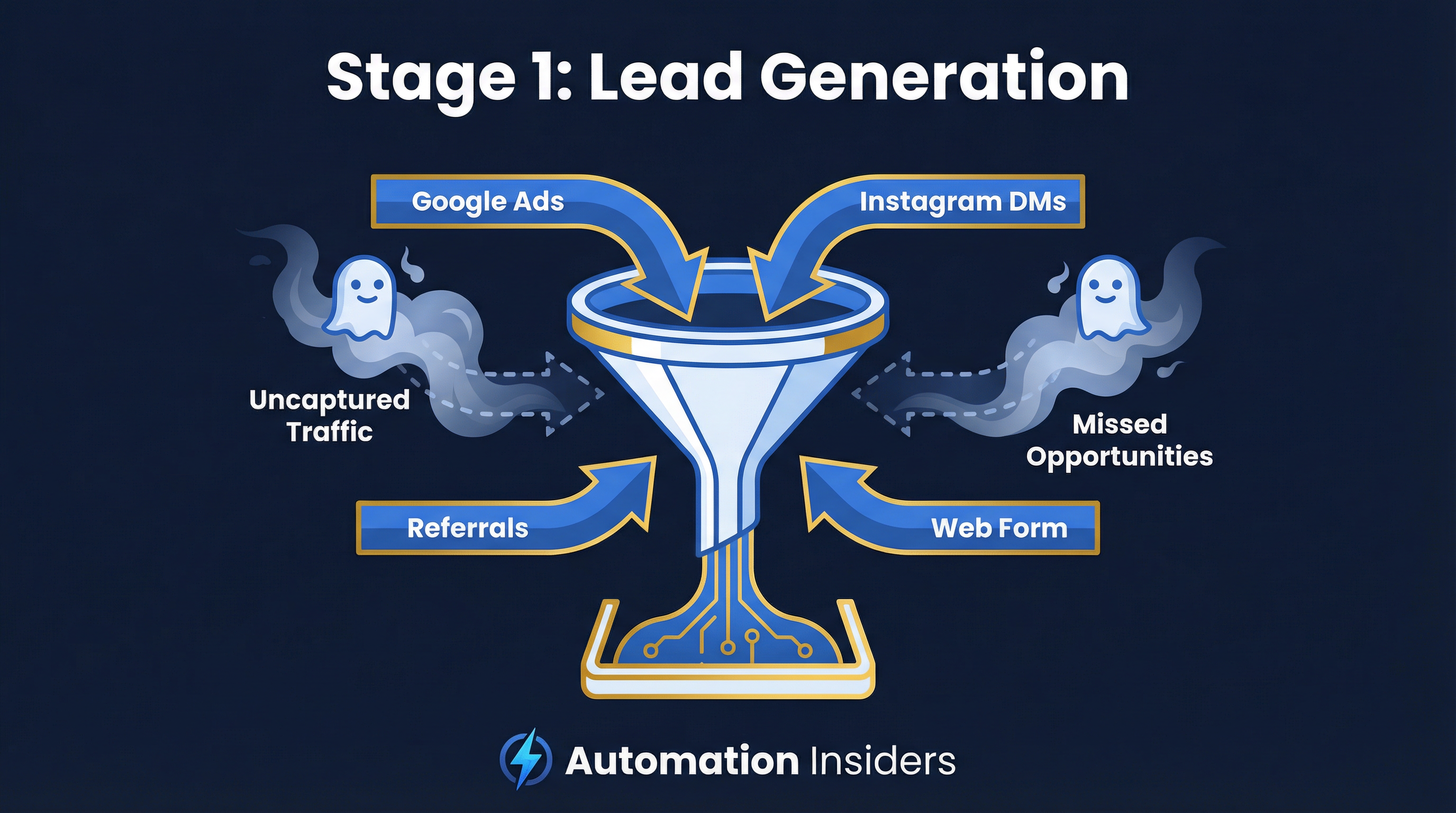
The fix starts with visibility. Every inbound channel — phone, form, DM, chat widget — needs to be tracked and responded to within a defined window. More on response time in a moment.
Stage 2: Missed Calls — The Most Expensive 30 Seconds in Business
Let us stay with Sarah for a moment.
On a typical Tuesday, her front desk phone rings 22 times. Jess answers 15 of them. The other 7 go to voicemail. Of those 7, maybe 2 leave a message. The other 5 hang up and — statistically — most of them call the next spa on Google.
This is not a Jess problem. This is a systems problem. One person cannot answer every call while also checking people in, processing payments, and managing the schedule. It is physically impossible.
But those 7 missed calls are not just inconveniences. They are revenue walking out the door.
| Metric | Value |
|---|---|
| Monthly inbound calls | 88 |
| Missed call rate | 32% |
| Calls missed per month | 28 |
| Estimated conversion rate (answered calls) | 22% |
| Potential new clients lost per month | ~6 |
| Average client lifetime value | $1,200 |
| Estimated monthly revenue lost | $7,200 |
Those numbers are conservative. A med spa with a $1,200 average lifetime value losing 6 potential clients per month is leaving $7,200 on the table — every single month. Over a year, that is $86,400 in revenue that was never captured, not because the marketing failed, but because the phone rang at the wrong moment.
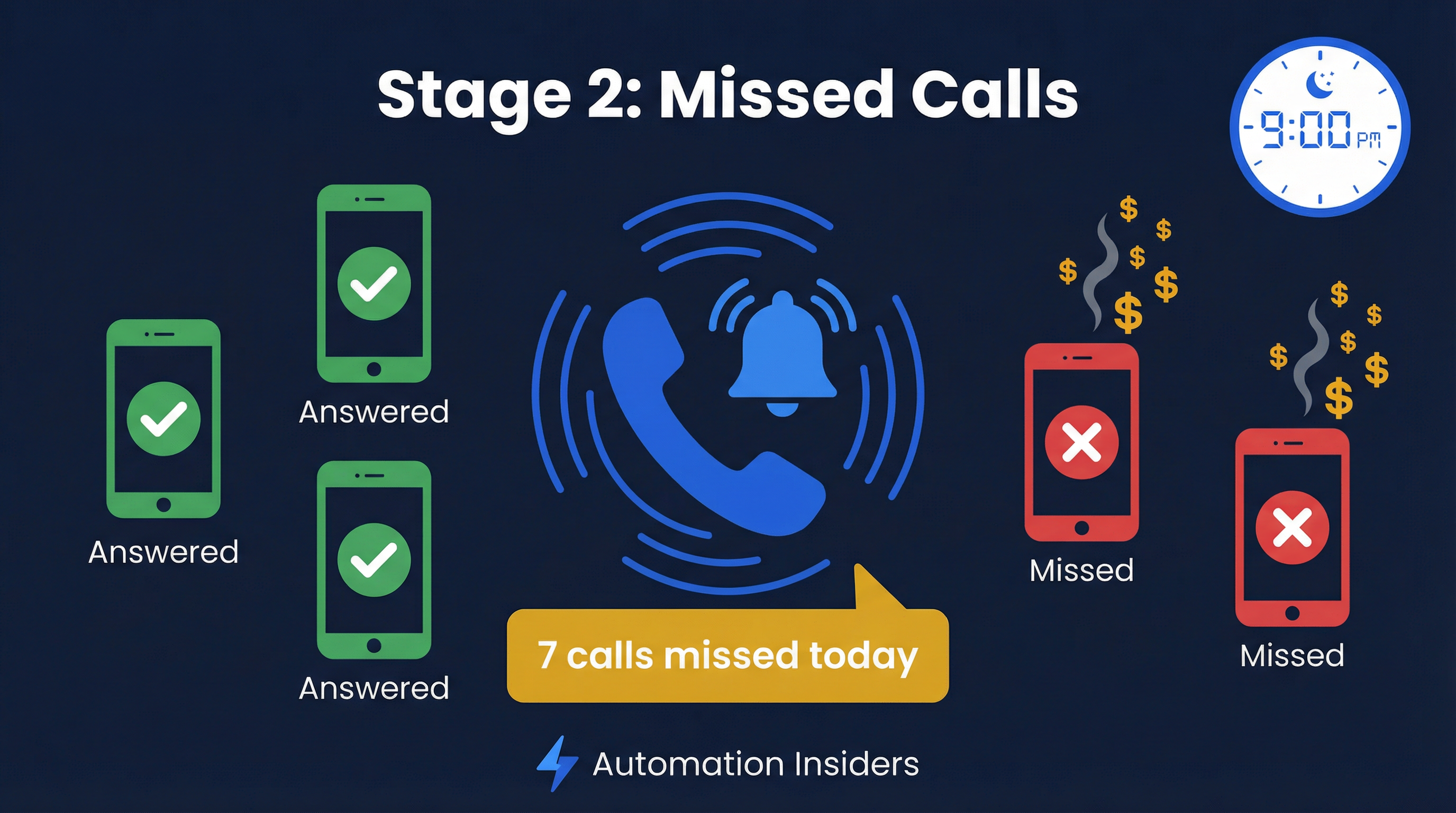
The research on this is consistent: businesses that miss calls without any follow-up lose the majority of those leads permanently. Most callers who reach voicemail do not leave a message, and most who do not leave a message do not call back.
If you want to see what this is costing your specific business, the Missed Call Revenue Calculator lets you plug in your own numbers — call volume, miss rate, average job or service value — and see the monthly and annual impact in under two minutes.
The solution is not hiring a second front desk person (though that helps). The most effective and immediate fix is an automated text-back the moment a call goes unanswered. Something like: "Hey, sorry I missed your call! I'm with a client right now. What can I help you with?" That single message, sent within 60 seconds of a missed call, keeps the conversation alive. It signals that you are responsive even when you are busy. And it converts a significant percentage of missed calls into booked appointments — without any human intervention.
Stage 3: Slow Lead Response Time — The 5-Minute Window That Changes Everything
Imagine two scenarios.
In the first, someone searches "med spa near me," clicks Sarah's Google Ad, fills out the contact form, and gets a call back within four minutes. They are still at their desk. They are still thinking about it. The conversation is easy.
In the second scenario, the same person fills out the same form. Jess sees it three hours later, between other tasks, and calls back. The person is in a meeting. She leaves a voicemail. They play phone tag for two days. By the time they actually speak, the person has already booked with a competitor.
The difference between those two scenarios is not the quality of the lead. It is the response time.
The data on this is striking. Studies on lead response time consistently show that the odds of reaching a prospect drop dramatically as response time increases — and the odds of converting them into a customer drop even faster.
| Response Time | Likelihood of Qualifying the Lead |
|---|---|
| Under 5 minutes | Very high — prospect is still engaged |
| 5–30 minutes | High — still warm, may have moved on |
| 30 minutes – 1 hour | Moderate — starting to cool |
| 1–24 hours | Low — likely contacted a competitor |
| 24+ hours | Very low — most have moved on |
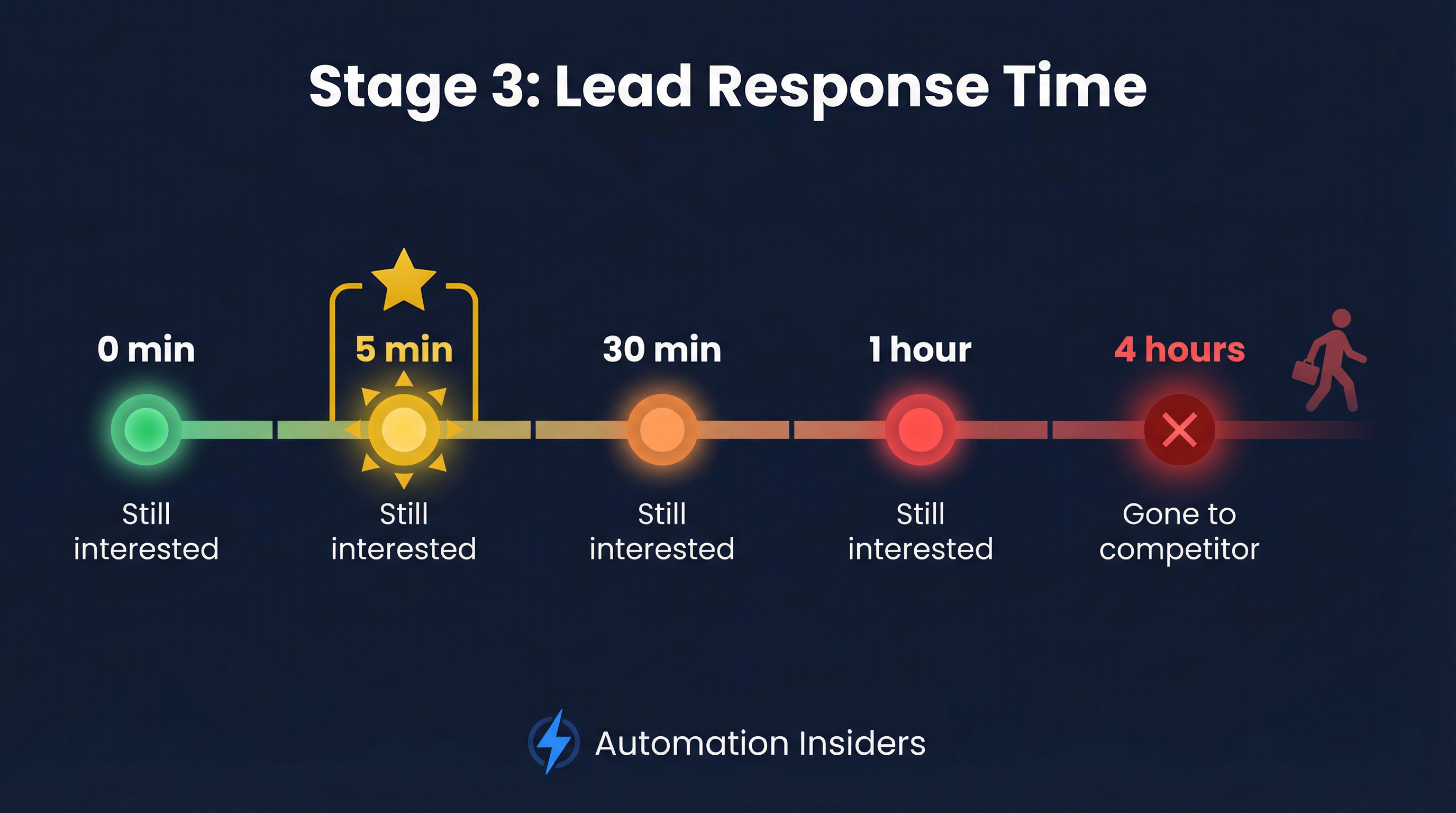
The 5-minute window is not arbitrary. It reflects the reality of how people shop for services today. When someone is actively searching and clicks your ad or fills out your form, they are in a decision-making moment. That moment has a short half-life. The longer you wait, the more that urgency fades — and the more time competitors have to step in.
For Sarah's med spa, the average response time to a web form submission is around 4 hours. That is not because Jess is negligent. It is because there is no system that alerts her immediately when a form comes in, and no protocol for how quickly it needs to be addressed.
The Lead Response Time Calculator can help you model what faster response times would mean for your conversion rate and revenue. The math is often surprising — even shaving your average response time from 4 hours to 30 minutes can have a meaningful impact on how many leads you actually convert.
Stage 4: Poor Follow-Up — The Fortune That Stays in the Follow-Up
Here is a scenario that plays out in Sarah's business every week.
A potential client calls, speaks with Jess, expresses interest in a Botox consultation, but says she wants to "think about it" and will call back. Jess writes her name on a sticky note. The sticky note ends up under a stack of intake forms. Three weeks later, Sarah is wondering why her new client pipeline is thin.
That woman never called back. She did not book somewhere else either — she just got busy, forgot, and the moment passed. If someone had followed up once, maybe twice, she almost certainly would have booked.
This is the follow-up leak, and it is one of the most expensive holes in the bucket because the leads are warm. They already expressed interest. They are not cold prospects — they are people who were close to saying yes and just needed one more nudge.
Research on sales follow-up consistently shows that the majority of sales require multiple contacts, but most salespeople (and business owners) give up after one or two attempts. The gap between "how many times most businesses follow up" and "how many times it actually takes to convert" is where a significant amount of revenue disappears.
| Follow-Up Attempt | % of Sales Closed at This Stage |
|---|---|
| 1st contact | ~2% |
| 2nd contact | ~3% |
| 3rd contact | ~5% |
| 4th contact | ~10% |
| 5th+ contact | ~80% |
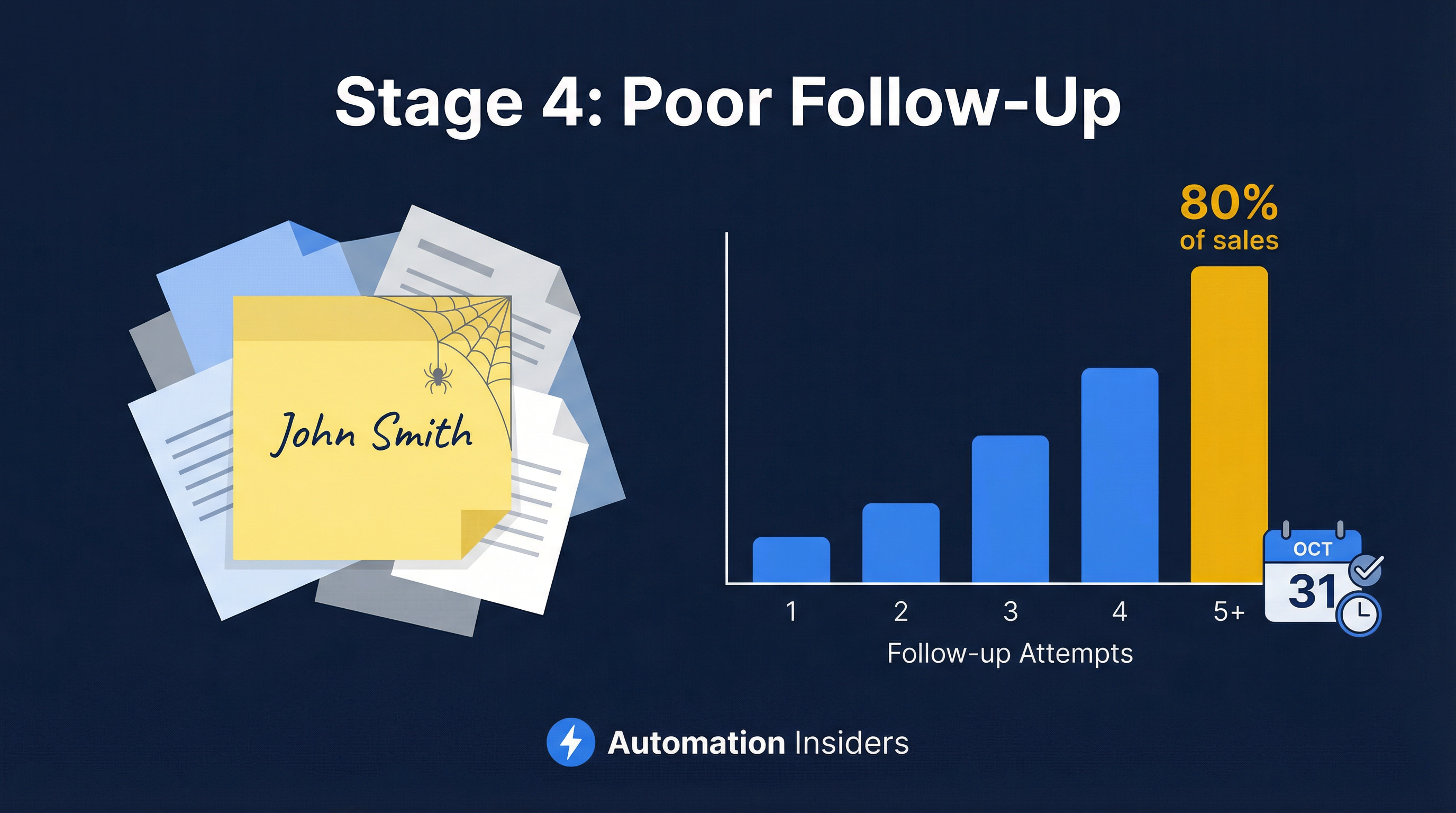
The implication is clear: most conversions happen after the 4th or 5th touchpoint, but most businesses stop following up after the 1st or 2nd. The leads are not bad. The follow-up is just absent.
For a small business like Sarah's, the challenge is that manual follow-up does not scale. Jess cannot be expected to remember to call back every prospect who said "maybe" — not while managing everything else. This is where automated follow-up sequences become genuinely valuable. A simple series of texts or emails — sent automatically over 5–7 days after an initial inquiry — can recover a meaningful percentage of leads that would otherwise go cold.
Stage 5: Appointment No-Shows — The Empty Chair Problem
Sarah's Tuesday schedule has 11 appointments. By end of day, 8 showed up. Three did not. One texted at the last minute. Two just never appeared.
Those three empty slots represent real, unrecoverable cost. The room was reserved. The aesthetician was paid. The supplies were prepped. And the revenue — somewhere between $300 and $600 per slot, depending on the service — simply did not materialize.
No-shows are one of the most frustrating leaks in the bucket because they happen after you have done everything right. The lead came in. They booked. They confirmed. And then they did not show up.
| Industry | Average No-Show Rate |
|---|---|
| Med Spa / Aesthetics | 15–30% |
| Dental | 10–25% |
| Mental Health / Therapy | 15–30% |
| Consulting / Coaching | 5–20% |
| Medical (General Practice) | 5–15% |
| Personal Training | 10–20% |
| Real Estate (Showings) | 15–25% |
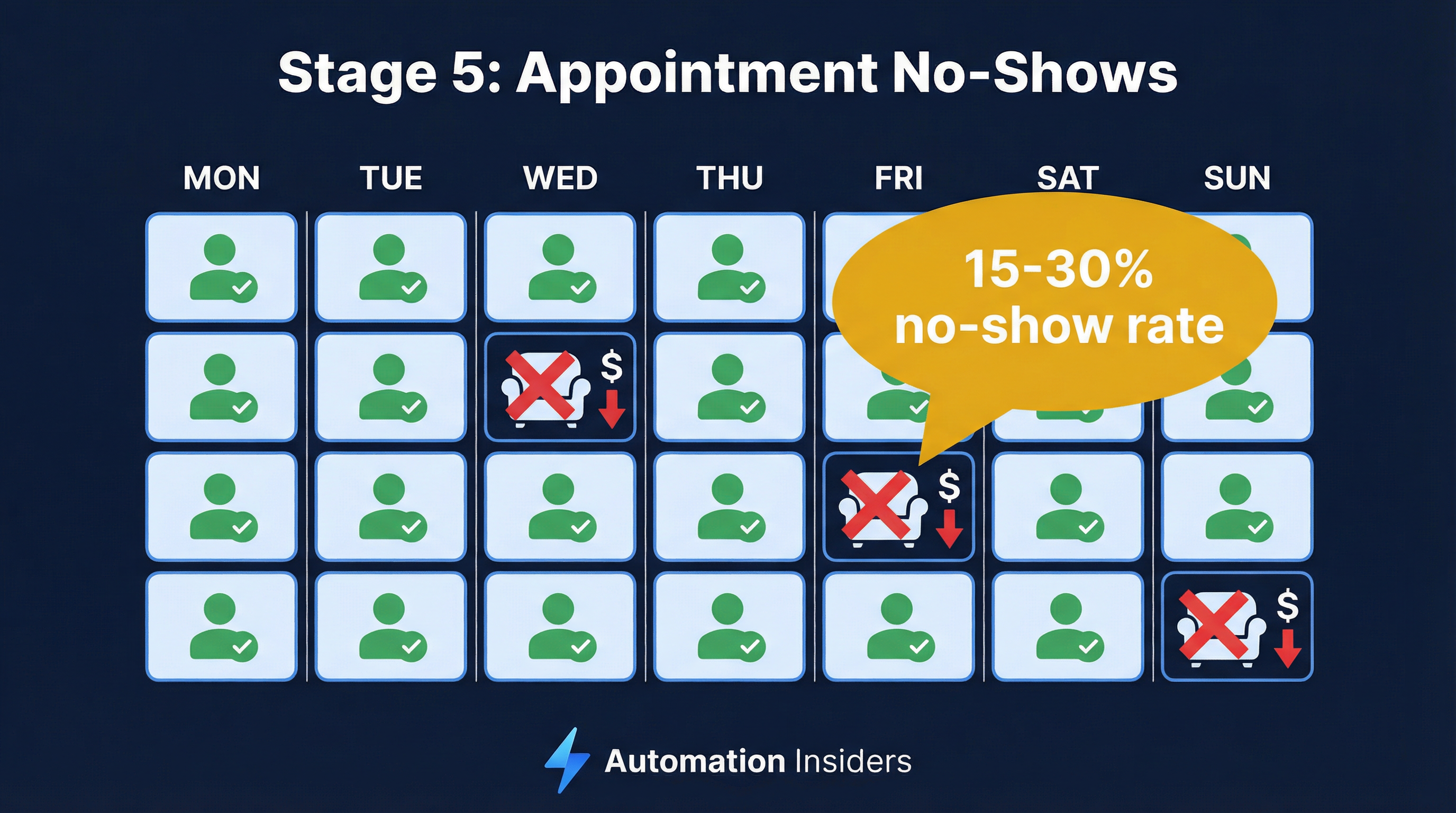
For a med spa running 40–50 appointments per week, even a 15% no-show rate means 6–8 empty slots every week. At an average service value of $200–$400, that is $1,200–$3,200 in lost revenue per week — or $62,000–$166,000 per year.
The Appointment No-Show Calculator lets you model this against your own numbers. Most business owners who run the calculation for the first time are genuinely surprised by the annual figure.
The good news is that no-shows are one of the most fixable leaks. Automated appointment reminders — sent 48 hours before, 24 hours before, and the morning of — consistently reduce no-show rates by 30–50%. A two-way confirmation (where the client has to reply "C" to confirm or "R" to reschedule) is even more effective because it creates an active commitment rather than a passive one.
Stage 6: Low Conversion Rates — When Leads Become Browsers Instead of Buyers
Not every leak is about speed or follow-up. Some of them are about what happens when you actually talk to a prospect.
Sarah has a consultation process that she has never formally examined. When someone comes in for a free Botox consultation, Jess walks them through a brief intake form, the aesthetician spends 15–20 minutes with them, and then… the prospect is handed a price sheet and told to "think about it." There is no structured close. No next step. No follow-up appointment booked before they leave.
About 40% of consultations convert to a booking. The other 60% walk out with a price sheet and good intentions.
This is a conversion rate problem, and it lives at the bottom of the funnel — which means it amplifies every other leak. If you improve your missed call rate, your response time, and your follow-up, but your consultation-to-booking conversion stays at 40%, you are still leaving 60% of your invested effort on the table.
| Funnel Stage | Sarah's Current Rate | Industry Benchmark |
|---|---|---|
| Calls answered | 68% | 80–90% |
| Leads followed up within 1 hour | 20% | 60–70% |
| Inquiries that book a consultation | 35% | 50–65% |
| Consultations that convert to booking | 40% | 55–70% |
| Booked clients who show up | 78% | 85–92% |
| Clients who rebook | 45% | 60–75% |
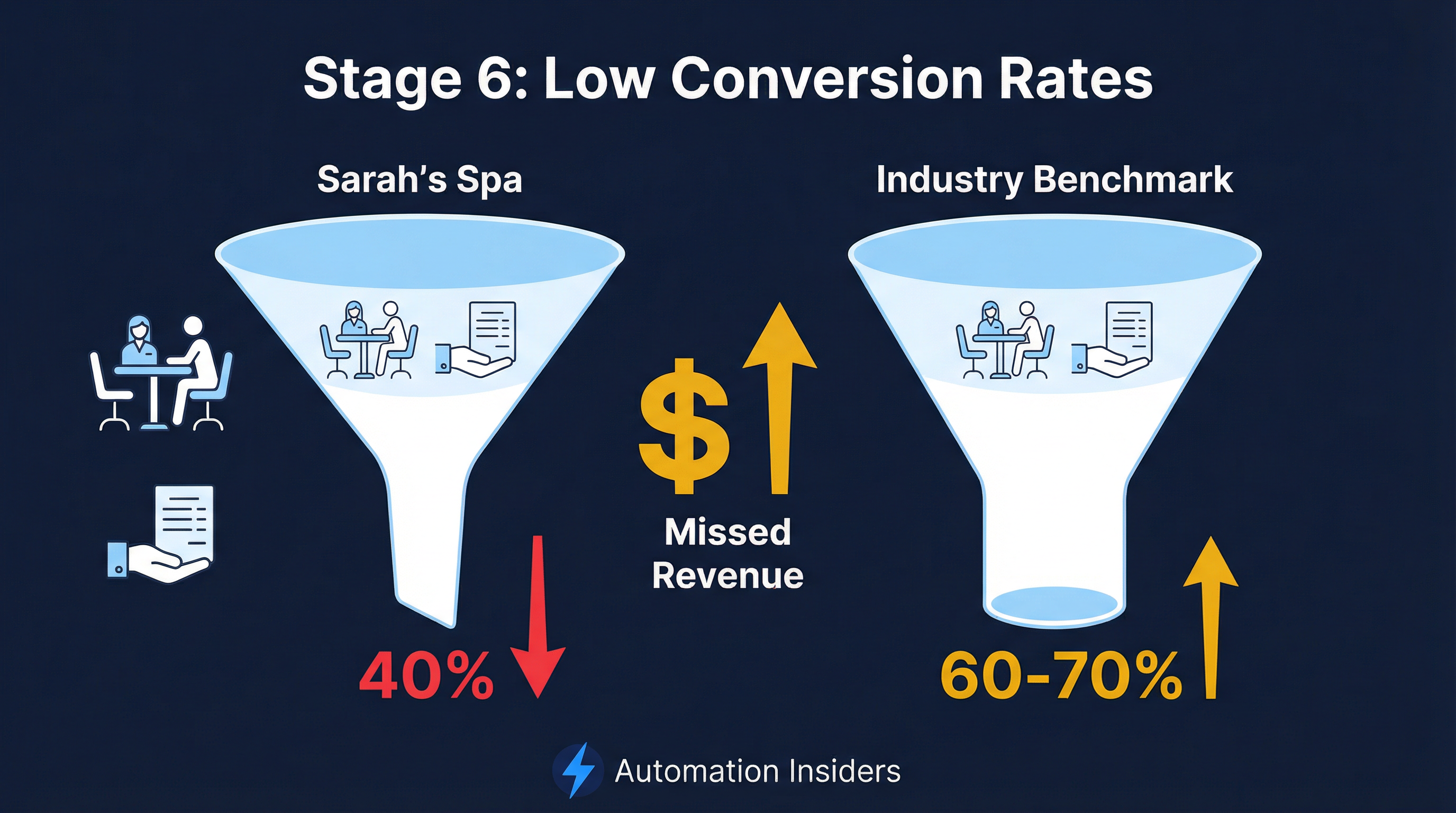
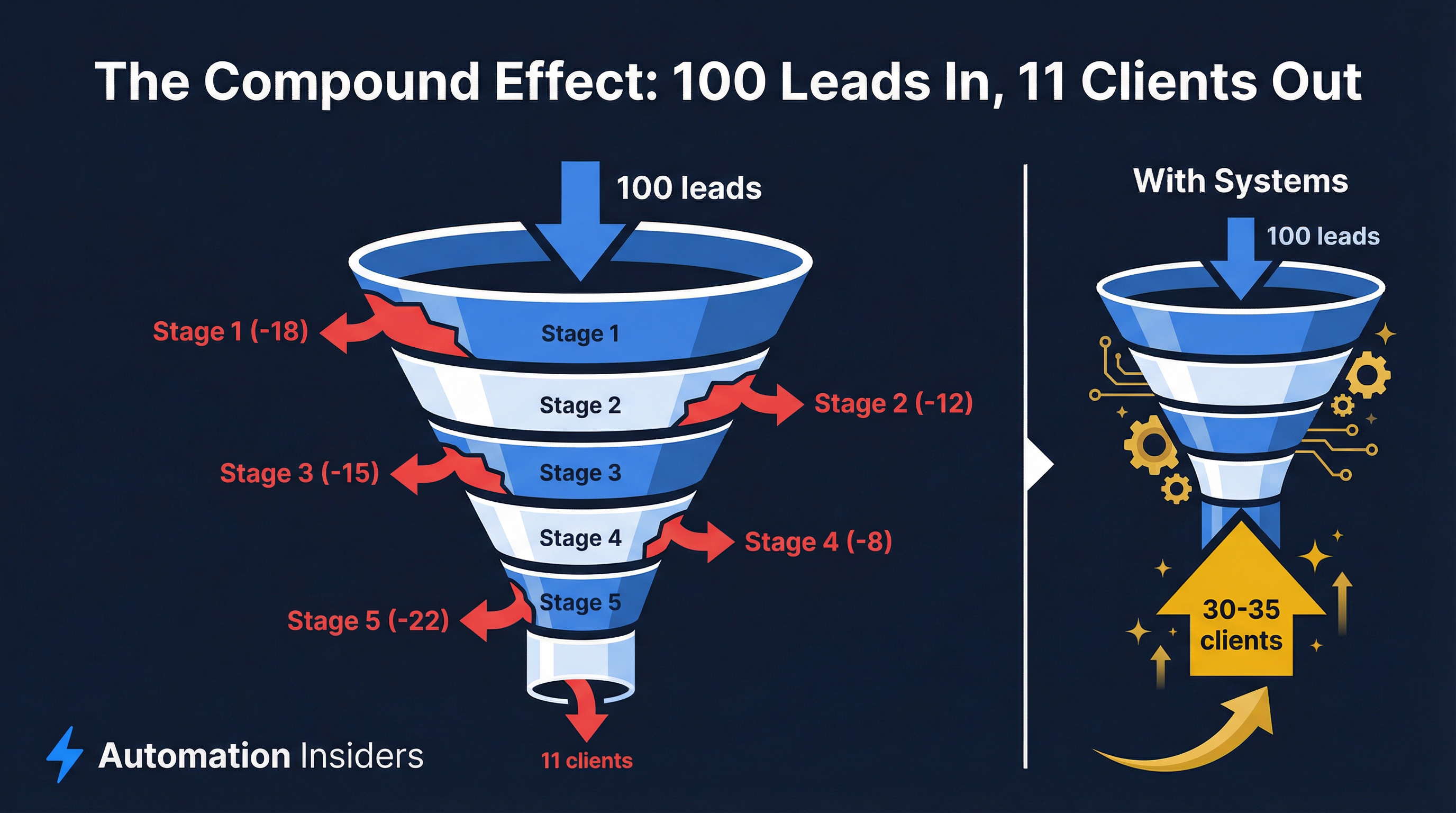
When you look at the full funnel, the compounding effect becomes visible. Sarah starts with 100 inbound inquiries. After missed calls, slow response, poor follow-up, no-shows, and conversion gaps, she ends up with roughly 11 paying clients from those 100 inquiries. A business operating at industry benchmarks across all stages would convert closer to 30–35 clients from the same 100 inquiries.
That is not a marketing problem. That is a systems problem.
Stage 7: Inefficient Tracking — Flying Blind in a Numbers Game
The final leak is the one that makes all the others invisible.
Sarah does not know her missed call rate. She has never calculated her average lead response time. She has no idea what her consultation-to-booking conversion rate is. She tracks revenue and appointments, but she does not track the journey that leads take to get there — or the journey of the ones who never arrived.
This is not unusual. Most small business owners are so focused on running the business that they never build the infrastructure to measure it. And without measurement, there is no way to know which holes are biggest, which fixes would have the most impact, or whether the changes you make are actually working.
| Metric | % of Small Businesses That Track It |
|---|---|
| Monthly revenue | ~90% |
| Appointment show rate | ~40% |
| Missed call rate | ~15% |
| Lead response time | ~10% |
| Consultation conversion rate | ~20% |
| Cost per acquired customer | ~25% |
| Lead source attribution | ~30% |
The businesses that grow consistently are almost always the ones that track these numbers — not because tracking is magic, but because it forces you to confront reality. When you know your missed call rate is 32%, you fix it. When you do not know, you keep spending on ads and wondering why revenue is not growing.
The Cost Per Lead Calculator is a good starting point for understanding what you are actually paying to acquire each customer — and whether the channels you are investing in are delivering a return worth the spend.
How the Leaks Compound: The Real Cost of Doing Nothing
Let us go back to Sarah and add up what her leaky bucket is actually costing her.
She starts with 100 inbound inquiries per month. Here is where they go:
| Stage | Leads Lost | Revenue Impact (Est.) |
|---|---|---|
| Missed calls (unanswered, no follow-up) | 18 leads | ~$4,300/month |
| Slow response time (>1 hour) | 12 leads | ~$2,900/month |
| No follow-up after initial contact | 15 leads | ~$3,600/month |
| Appointment no-shows | 8 clients | ~$2,400/month |
| Low consultation conversion | 22 leads | ~$5,300/month |
| Total estimated monthly loss | ~$18,500/month | |
| Total estimated annual loss | ~$222,000/year |
These are estimates based on conservative assumptions about Sarah's service values and conversion benchmarks. Your numbers will be different. But the pattern — multiple small leaks compounding into a significant annual loss — is consistent across virtually every service business I have seen.
The uncomfortable part is that none of these losses show up as a line item. There is no invoice for "missed calls: $4,300." The money simply never arrives. It is invisible revenue — the kind that is hardest to fix because you have to first believe it exists.
Plugging the Holes: Where Automation Changes the Equation
Here is the thing about the leaky bucket: most of the holes can be plugged without hiring more people.
The reason Sarah's bucket leaks is not that she has bad employees or a bad product. It is that the systems she relies on are manual, reactive, and dependent on human memory and availability. Jess cannot answer every call. She cannot follow up with every prospect. She cannot send reminder texts to every appointment. She is one person.
Automation does not replace Jess. It gives Jess leverage.
When a call goes unanswered, an automated text goes out within 60 seconds — no human required. When a form is submitted, an automated email and text sequence starts immediately — no human required. When an appointment is booked, a reminder sequence fires at 48 hours, 24 hours, and the morning of — no human required. When a consultation does not convert, a follow-up sequence starts automatically — no human required.
This is what platforms like GoHighLevel are designed to do for small businesses. It is not a CRM in the traditional sense — it is a system for ensuring that no lead falls through the cracks, no matter how busy the front desk is. The missed call text back, the automated follow-up sequences, the appointment reminders, the two-way SMS — these are not nice-to-haves. For a service business running on thin margins and a small team, they are the difference between a leaky bucket and a full one.
The irony is that most of these automations cost less per month than the revenue lost in a single missed call.
A Diagnostic for Your Own Business
Before you close this article, take five minutes to honestly answer these questions about your own business:
On missed calls:
- What percentage of your inbound calls go unanswered on a typical day?
- What happens to those callers? Do they get a text back, or do they disappear?
On response time:
- How long does it take your business to respond to a web form submission or online inquiry?
- Is that response time consistent, or does it depend on who is working that day?
On follow-up:
- How many times do you follow up with a prospect who expressed interest but did not book?
- Is that follow-up systematic, or does it happen when someone remembers?
On no-shows:
- What is your current appointment no-show rate?
- What do you do when someone no-shows — do you attempt to rebook them?
On conversion:
- What percentage of consultations or discovery calls convert to a sale or booking?
- Have you ever formally measured this number?
On tracking:
- Do you know your cost per acquired customer?
- Do you know which marketing channels are producing the highest-quality leads?
If you answered "I don't know" to more than two of those questions, you have a visibility problem — and visibility is the prerequisite for fixing everything else.
Closing the Bucket
Sarah's med spa is not failing. It is doing reasonably well by most measures. But it is operating at maybe 60% of its potential revenue — not because the market is bad or the product is wrong, but because there are holes in the bucket that have never been identified, let alone fixed.
The leaky bucket is not a metaphor for catastrophic failure. It is a metaphor for the slow, quiet, invisible revenue loss that happens in almost every small business — the leads that almost converted, the calls that almost got answered, the appointments that almost showed up.
The good news is that plugging these holes does not require a bigger marketing budget. It requires systems — and increasingly, those systems are accessible to businesses of every size.
Start with visibility. Know your numbers. Run the calculators. Understand where your specific bucket is leaking before you spend another dollar trying to pour more water into the top.
Then fix the holes, one by one.
The water you are already paying for should be enough to fill the bucket. You just have to stop losing it.
Want to see exactly how much revenue your business is losing at each stage? Use our free calculators:
- Missed Call Revenue Calculator — See the annual cost of unanswered calls
- Lead Response Time Calculator — Model the impact of faster follow-up
- Appointment No-Show Calculator — Calculate your no-show revenue loss
- Cost Per Lead Calculator — Understand what you are actually paying per customer
About this article: This post is part of the Automation Insiders content series on small business revenue optimization. Our goal is to give business owners the data, frameworks, and tools to understand where their revenue is going — and how to keep more of it.
Affiliate Disclosure: I am an independent HighLevel Affiliate, not an employee. I receive referral payments from HighLevel. The opinions expressed here are my own and are not official statements of HighLevel LLC.
Related Articles
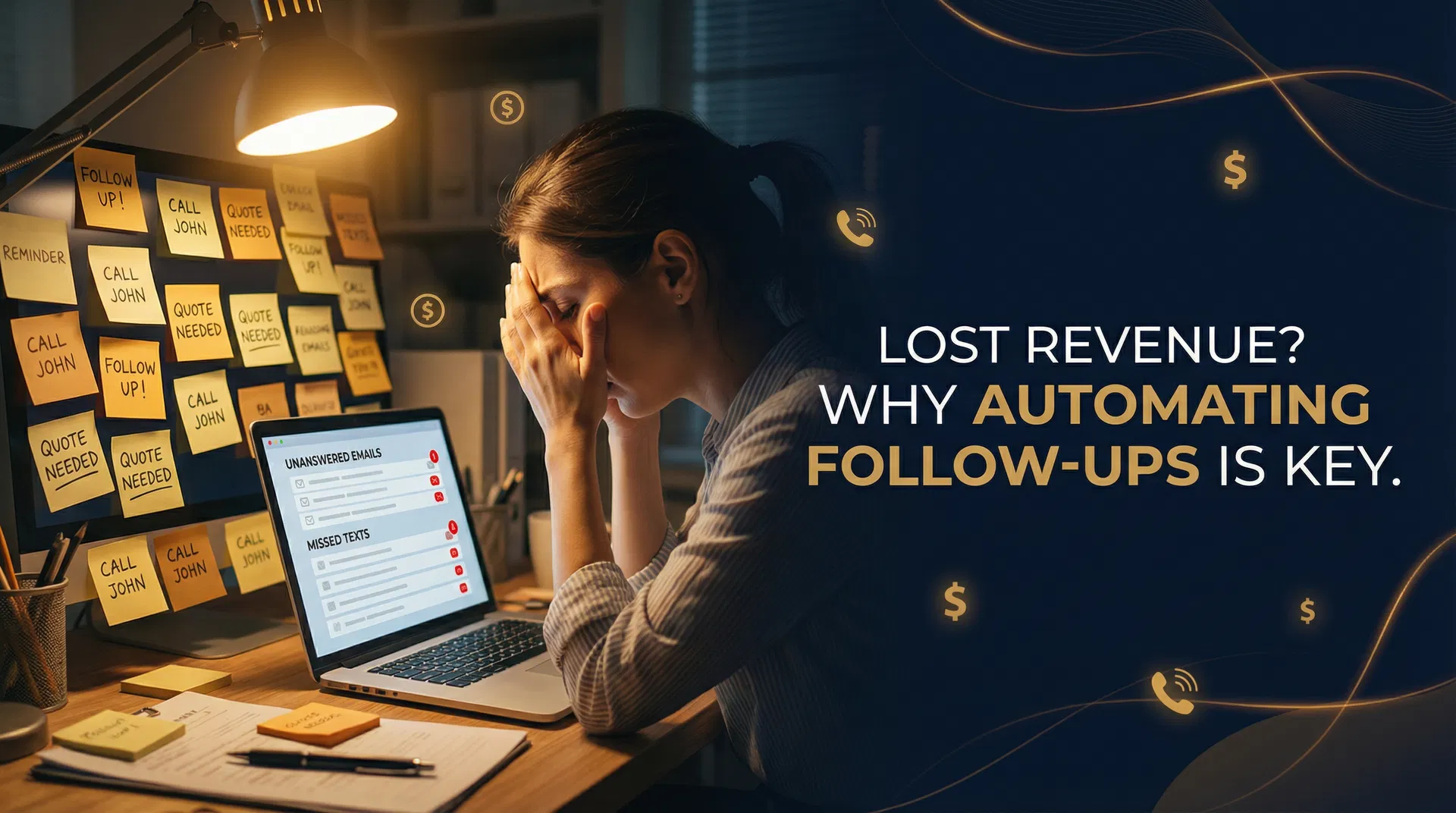
The $126,000 Follow-Up Problem: Why Your Leads Are Walking Away
Stop losing leads! Discover the $126,000 small business follow-up problem and how automated systems can recover lost revenue and boost your growth.

How Much Revenue Are You Losing to Missed Calls? (With Calculator)
Stop losing money to missed calls. Use our guide to calculate your missed call revenue loss and learn how to recover it with proven strategies for local service businesses.
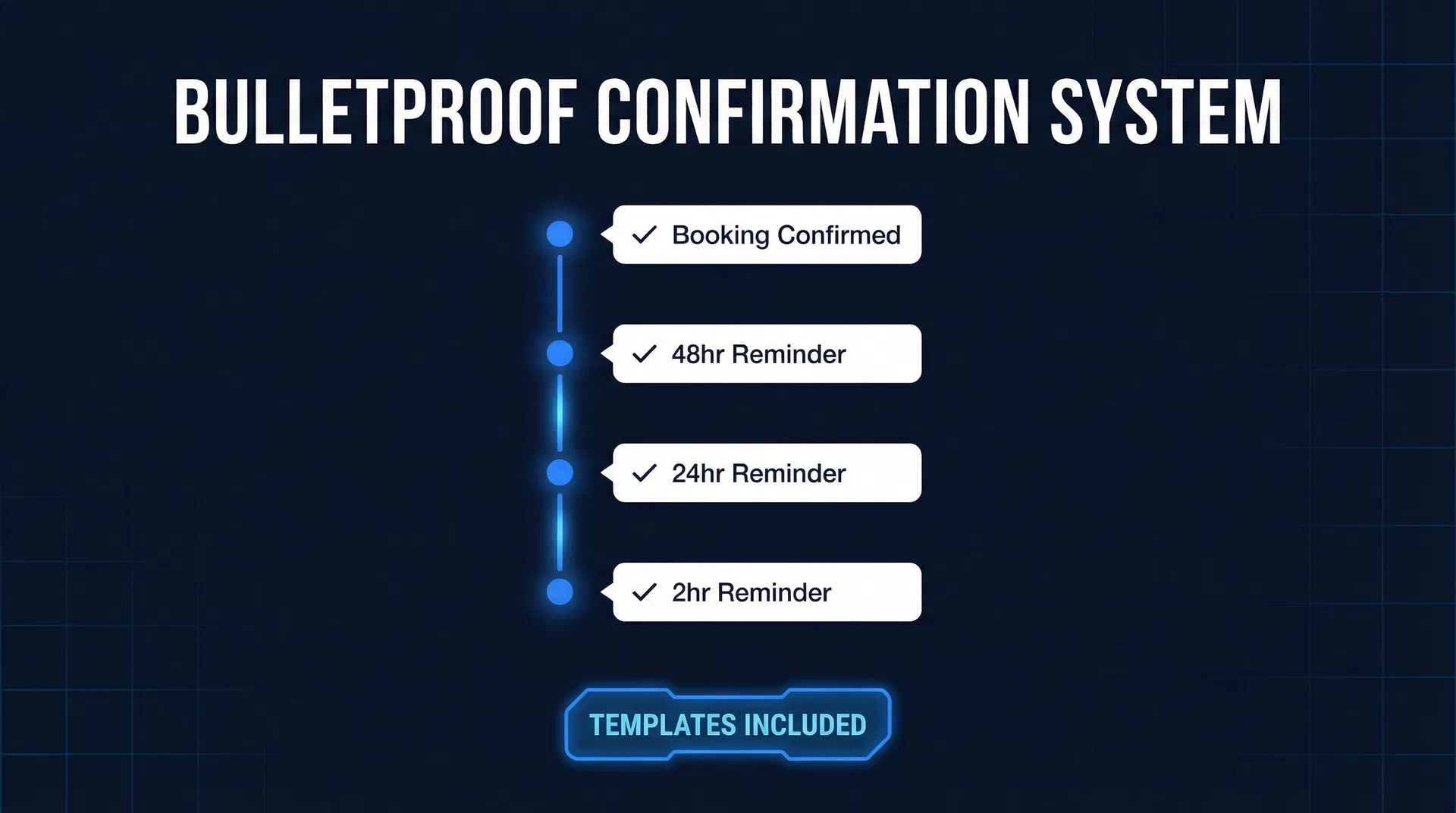
A Bulletproof Appointment Confirmation System for Your Local Business
Tired of no-shows? Implement this 6-part appointment confirmation system for your small business. Reduce no-shows, recover revenue, and keep your schedule full.